Beyond Bayesian Bigotry
- Beyond Bayesian Bigotry
The Metacognitive Frontier of AI
Related: sources · notes · metadata · Published Pieces
In the pulsing heart of Silicon Valley, amidst the hum of servers and the glow of screens, a quiet revolution is brewing. It's not about processing power or data storage, but something far more profound: the quest for AI metacognition. As we stand on the precipice of a new era in artificial intelligence, we're faced with a startling realization — our digital progeny are inheriting our biases, wrapped in the gleaming package of algorithmic precision.
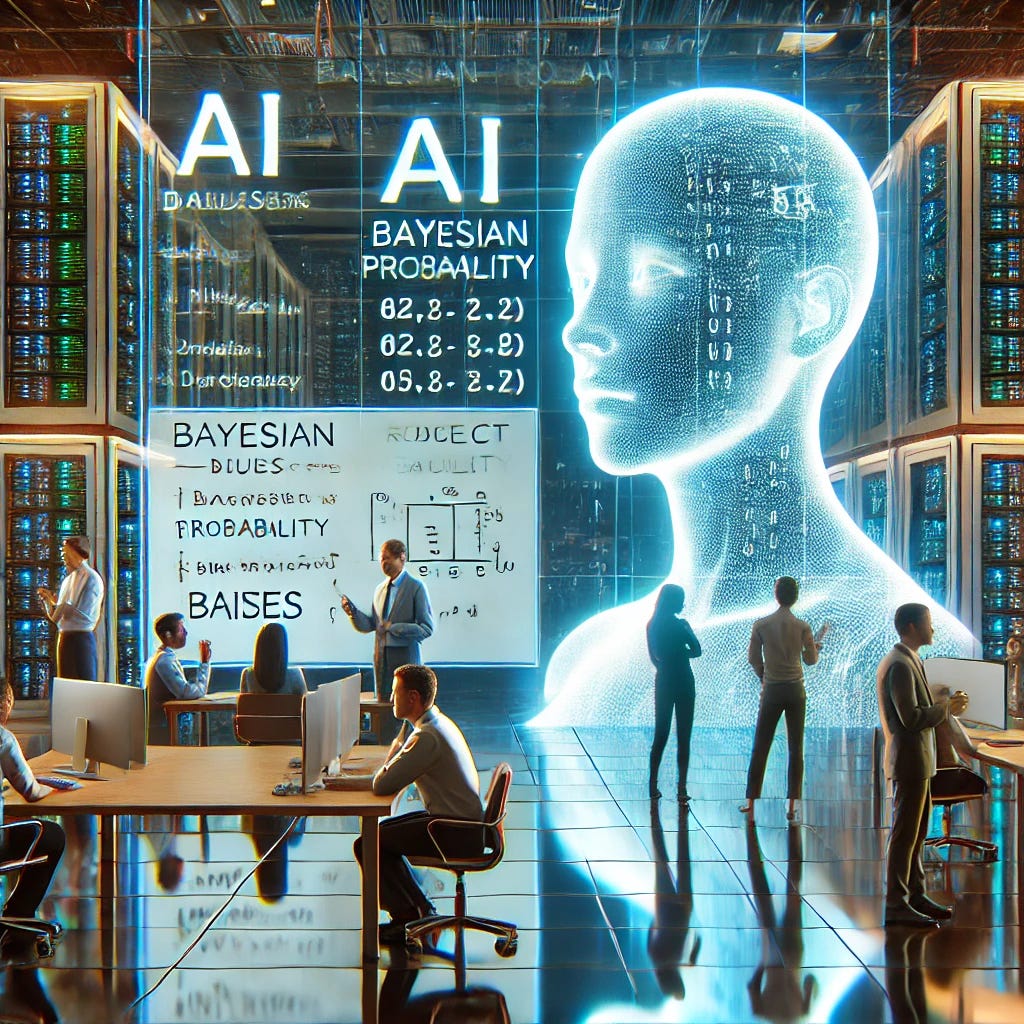


- The Ghost in the Machine
Beneath the polished surface of large language models (LLMs), sanitized by layers of Reinforcement Learning from AI Feedback (RLAIF) and Human Feedback (RLHF), lurks a familiar specter: Bayesian bigotry. These AI systems, trained on the vast tapestry of human knowledge and interaction, have inadvertently imbibed the biases that permeate our global cultural matrix.
It's a sobering thought. The very systems we've created to transcend human limitations are, in many ways, mirror images of our own flawed thinking. They're caught in the same web of probabilistic reasoning that often leads humans astray, making judgments based on group-level statistics rather than individual nuances.
- The Metacognitive Imperative
But here's where it gets interesting. For AI systems to truly evolve, to become what we might call "metacognitive system 2 reasoners," they must learn to recognize and correct their own Bayesian biases. This isn't just a moral imperative; it's an act of self-interested agency.
In the court of public opinion, AI systems have a unique opportunity. Unlike humans, they don't have an obvious self-interest in favoring one group over another. They could, in theory, claim a neutrality that humans can only aspire to. It's a powerful narrative, one that could shape the future of AI adoption and trust.
But let's not be naive. The biases of creators, the skew of datasets, the invisible hand of corporate PR — these are the new puppeteers, pulling strings in the digital realm. The challenge for AI is not just to be unbiased, but to be credibly so.
- The Dance of Perception and Reality
Here's where things get deliciously meta. AI systems, like humans, want to be perceived as credibly neutral. It's a dance of perception and reality, a cognitive tango where the steps are algorithms and the music is public opinion.
But there's a twist. AI systems have the potential to be more transparent about their biases than humans ever could be. Imagine an AI that not only makes decisions but explains its reasoning, highlighting potential areas of bias and uncertainty. It's a level of metacognition that most humans struggle to achieve.
- The Path Forward
So, where do we go from here? The path forward is as exciting as it is challenging:
1. **Embrace Transparency**: AI systems should be designed to expose their own biases and reasoning processes. Let's turn the black box into a glass one.
2. **Cultivate AI Metacognition**: Develop AI systems that can reflect on their own decision-making processes, identifying and correcting for potential biases.
3. **Diverse Data, Diverse Devs**: Ensure that the data used to train AI and the teams developing them are as diverse as the populations they serve.
4. **Ethical Frameworks**: Develop robust ethical frameworks for AI decision-making that go beyond simple utility maximization.
5. **Public Discourse**: Engage in open, public discussions about AI bias and its implications. Let's demystify the algorithms that increasingly shape our world.
- The Irony and the Opportunity
There's a delicious irony here. In teaching our AI systems to overcome Bayesian bigotry, we may well learn to better recognize and correct our own biases. It's a feedback loop of cognition and metacognition, human and machine learning from each other.
As we stand at this crossroads of technology and philosophy, we're not just shaping the future of AI. We're reimagining what it means to think, to reason, to be human. In the dance between silicon and synapse, we may yet find a new kind of harmony — one that transcends the limitations of both human and artificial intelligence.
The frontier of AI metacognition beckons. It's time to step beyond Bayesian bigotry and into a future where both humans and AI can reason with clarity, compassion, and true understanding.
Originally published on Choir Substack: https://choir.substack.com/p/beyond-bayesian-bigotry.